

Intelligence Briefing: Freight Forwarders and Logistics Planner
- Softlink Global

- Mar 9
- 2 min read
BoxyAI - Global Trade Lane Risk Outlook - Date: March 9, 2026
SECTION 1: STRATEGIC CONTEXT
Maritime trade has entered a permanent state of displacement. The Suez Canal remains operationally irrelevant for Tier-1 carriers due to kinetic threats. The Cape of Good Hope rerouting is now the baseline, absorbing approximately 12% of global container ship capacity.
The capacity deficit is compounding. Longer voyages prevent timely vessel returns to Asian
export hubs, resulting in structural equipment shortages in Ningbo and Shanghai. Bunker fuel prices are on a +12% 30-day slope. Expect sustained rate volatility and schedule instability through the current month.
SECTION 2: TRADE LANE RISK METRICS

SECTION 3: CHOKEPOINT WATCH
Strait of Hormuz Threat Level: Critical. Increased naval posturing has forced war risk premiums to multi-year highs. This is the primary point of failure for Indian and Gulf trade. Any escalation will halt regional feeder services and trigger global fuel price spikes.
Bab el-Mandeb & Suez Canal: Transits down 70% against historical averages. Treat the Cape of Good Hope as the mandatory route. No indicators suggest a return to Suez transit safety within the 30-day forecast window.
Panama Canal: Operating under restricted reservation slots. High demand for East Coast diversions has created an auction-style pricing environment for transit slots, increasing landed costs.
Strait of Malacca: Congestion is rising. Rerouted vessels are arriving in clusters at the Singapore hub. Expect 3-day berthing delays for vessel bunching.
SECTION 4: COST TRAJECTORIES:

SECTION 5: TACTICAL DIRECTIVES
1. 15-Day Buffer: Apply a mandatory 15-day extension to all Asia-Europe lead times.
2. 4-Week Bookings: Secure equipment and space 28 days before Estimated Time of
Departure (ETD).
3. Air Freight Safety Valve: Utilize air freight for high-value components to bypass the 20-day
ocean delay.
4. Insurance Audit: Verify war risk coverage for any cargo transiting the Persian Gulf or Red
Sea proximity.
5. FCL Priority: Prioritize Full Container Load (FCL). Carriers are deprioritizing complex LCL
consolidations.
SECTION 6: 30-DAY PREDICTIVE OUTLOOK
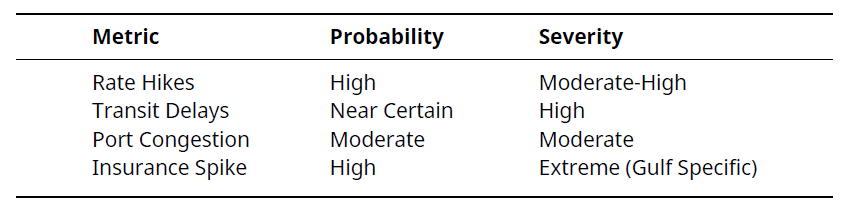
Rate Volatility (85% Probability): Spot rates predicted to increase 20% by mid-April.
Structural Delays(95%Probability): No improvement expected for Asia-Europe transit times.
Terminal Saturation(60%Probability): Increased yard density at Rotterdam and Singapore.
Insurance Spikes (75% Probability): Continued Hormuz tension will double war risk
surcharges.
Risk Summary Table
Conclusion
Logistics operations are defined by geographic displacement. The fleet’s buffer capacity is exhausted. Transparency regarding cost shifts and transit extensions is mandatory.
ENGINEERED BY BOXYAI
The Neural Intelligence Core of Logi-Sys and Softlink Global
INTELLIGENCE DISCLAIMER:
This briefing constitutes a predictive assessment derived from algorithmic signal processing and geopolitical data analysis. The outputs are intended for strategic foresight and do not represent guaranteed financial or operational outcomes. BoxyAI, Logi-Sys, and Softlink Global assume no liability for commercial decisions or losses incurred based on the predictive modeling contained herein. Data is current as of the timestamp provided and is subject to immediate revision based on shifting kinetic or market signals.


